Your path into the industry
Can you please introduce yourself and tell us about your current role?
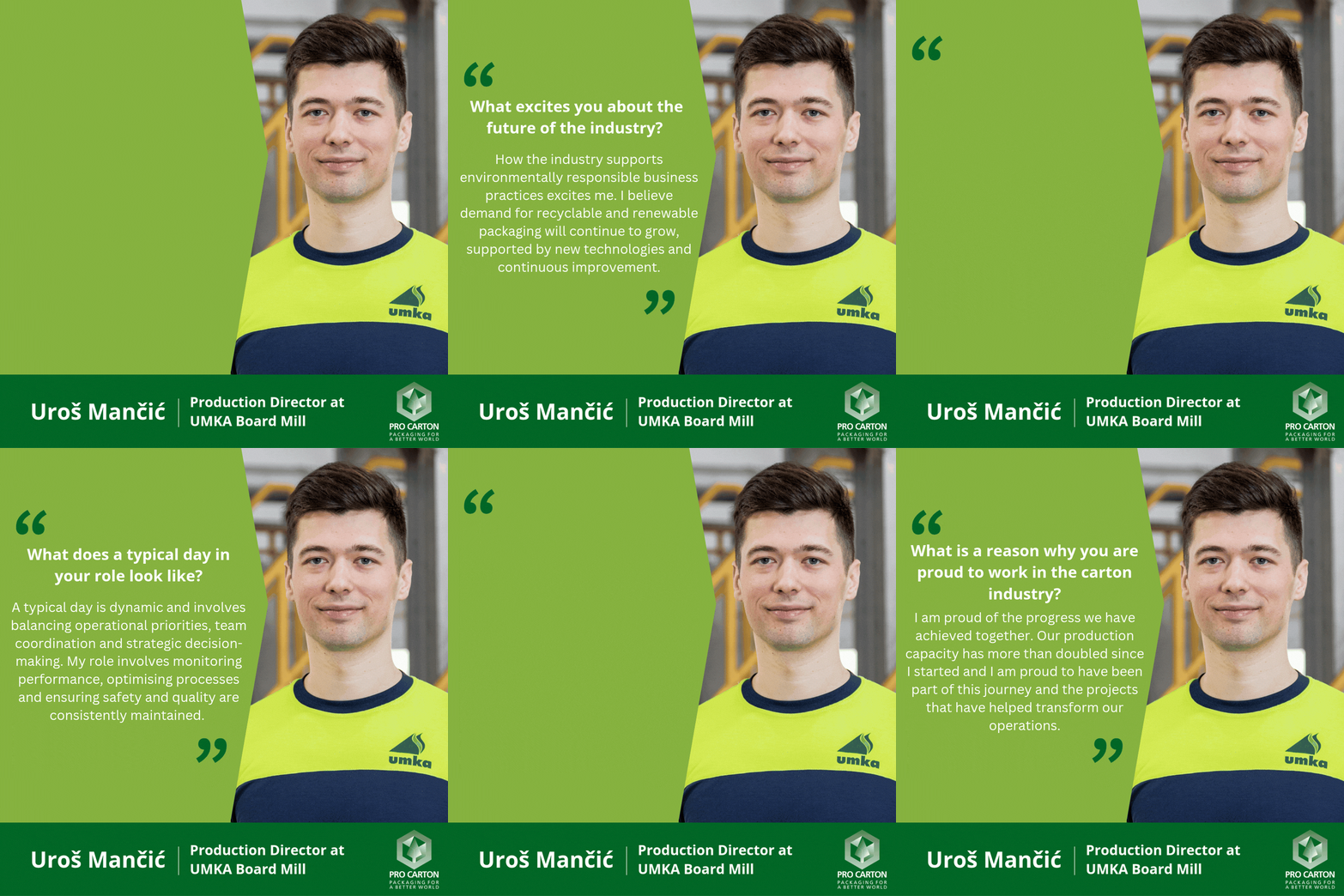
My name is Uroš Mančić, and I am currently working as Production Director at UMKA Board Mill.
I have spent the past 11 years at UMKA Board Mill, joining as a graduate production engineer and progressing through different production departments. Throughout my career, I have been involved in production planning, continuous improvement, cost optimisation and cross-functional coordination.
What initially sparked your interest in the sustainable packaging and cartonboard industry?
I have always been interested in manufacturing environments where operational efficiency and product quality play an important role. Over time, I became increasingly motivated by the industry’s contribution to sustainable and recyclable packaging solutions and its growing importance as environmental awareness continues to increase.
Another aspect that inspired me was the complexity of the production process itself. Balancing productivity, quality, cost efficiency and sustainability requires continuous improvement and strong teamwork. That combination of technical, operational and environmental challenges is something I truly enjoy.
What has been the most significant milestone or experience that has shaped your career to date?
One of the most significant experiences in my career was UMKA’s major investment cycle between 2021 and 2024, during which we transformed our production processes.
In 2021, I worked as a piping and start-up engineer during the wet end reconstruction, including the transition from rotary formers to forming fabrics and the installation of a curtain coater and new winder. In 2022, I led the complete reconstruction of stock preparation, including a new OCC line and reconstruction of the top and back ply lines. In 2023, I again worked as a piping engineer during the reconstruction of the drying group, and in 2024 I was one of the start-up engineers for the installation of new coating dryers.
These projects helped me grow not only as an engineer and production manager, but also as a leader, strengthening my ability to motivate teams, manage pressure, solve problems quickly and deliver improvements on schedule.
Were there any specific challenges or turning points that you feel were pivotal in your professional journey?
One of the most challenging and defining periods in my career was managing production operations during the COVID-19 pandemic and lockdown. The industry faced significant uncertainty, from workforce organisation and health protection to supply chain disruption and changing demand. As part of the production leadership team, my responsibility was to ensure business continuity while protecting employees and maintaining stable production performance.
This period required constant adaptation, fast decision-making and strong communication. We reorganised shifts, managed operational risks in real time and maintained efficiency under extremely difficult circumstances. The experience strengthened my leadership skills, resilience and ability to manage complex situations under pressure, while reinforcing the importance of teamwork, trust and flexibility.
Another important turning point was transitioning from a technical and operational role into a leadership position with broader strategic responsibility. This shift required me to further develop communication, people management and organisational skills while still maintaining a strong focus on production performance and continuous improvement.
How has the industry changed since you first started, and what excites you most about its future?
Since I started in the industry, the biggest changes have been the increased focus on sustainability, technological development and operational efficiency. Customers now expect not only high product quality but also sustainable, flexible solutions with lower environmental impact, driving investment in process optimisation, recycling, energy efficiency, automation and digitalisation.
What excites me most is the important role the board and paper industry plays in the transition toward more environmentally responsible business practices. I believe demand for recyclable and renewable packaging solutions will continue to grow, supported by new technologies and continuous improvement.
Daily impact
What does a typical day in your current role look like?
A typical day in my role as Production Director at UMKA Board Mill is dynamic and involves balancing operational priorities, team coordination and strategic decision-making.
My day usually begins with reviewing production results, safety indicators, quality performance and operational issues from the previous shift. Through daily morning meetings with technical departments, we ensure production plans stay on track and challenges are resolved quickly.
A significant part of my role involves monitoring performance, optimising processes and ensuring safety and quality standards are consistently maintained. Since unexpected situations can arise at any moment, adaptability and fast decision-making are essential.
What I enjoy most is working closely with people, supporting teams and building a culture of teamwork and continuous improvement. Alongside daily operations, I am also involved in longer-term planning, investment discussions and sustainability initiatives.
Can you describe a specific project or initiative you’ve worked on recently that you found particularly exciting or innovative?
One of the most exciting projects I am currently involved in is an energy-efficiency initiative at UMKA Board Mill.
The project focuses on replacing traditional water vacuum pumps with modern turbo blowers, significantly reducing electricity consumption and freshwater use while improving operational efficiency and environmental sustainability.
What makes this project particularly interesting is that it combines technological modernisation with measurable sustainability benefits. Projects like this are especially motivating because they show how innovation and sustainability can create long-term value for both the company and the environment.
How does your work directly contribute to the sustainable and environmental benefits of cartonboard packaging?
My work contributes to sustainability through improving production efficiency, optimising resource consumption and supporting continuous improvement. The more efficiently we operate, the more effectively we reduce energy use, minimise waste and manage resources responsibly, as demonstrated by our current energy-efficiency project, which will reduce both electricity and water consumption while improving production performance.
What advice would you give to someone who is just starting their career in this industry?
Stay curious, be patient and remain open-minded. Focus on learning from both people and everyday operational challenges.
This industry offers many opportunities for professional growth, and those willing to learn, take responsibility and work collaboratively can develop quickly.
What is the one reason why you are proud to work in the carton and carton board industry?
One of the main reasons I am proud to work in the cartonboard industry, is the progress we have achieved together.
When I started eleven years ago, our production capacity was slightly below 100,000 tonnes per year. Today, we are producing around 220,000 tonnes annually, with plans for further growth. I am proud to have been part of this journey and the projects that have helped transform our operations.
Beyond your role
What’s a skill or hobby you have outside of work that has surprisingly helped you in your role?
One hobby that has helped me significantly in my professional role is ultra-trail running.
Ultra-trail running has taught me discipline, resilience and endurance- qualities equally important in leadership and manufacturing environments. It requires focus, managing pressure and adapting to unexpected situations, much like managing complex production operations.
I see many similarities between endurance sports and manufacturing: success depends on preparation, persistence, teamwork and remaining calm under pressure. Spending time outdoors helps me maintain balance and return to work with more energy and focus.
What’s the best piece of career advice you’ve ever received?
Pay attention to details, because even small things can create big results.
If you could have any other job in packaging for a day, what would it be and why?
If I could have any other role in the packaging industry for a day, I would choose to be a process technology designer for stock preparation or board and paper machines.
I have always been interested in the technical side of production and how complex machinery and process systems are designed to achieve efficiency, stability and high product quality. Stock preparation and machine operations are at the heart of production, and I find the engineering behind them extremely interesting.
What is the one thing you wish more people knew about the carton and cartonboard industry?
Many people see packaging only as a final product, but behind it lies a highly complex industrial process requiring advanced technology, skilled people, continuous innovation and strong operational discipline.
Modern cartonboard production involves advanced process control, recycling systems, automation and continuous optimisation. It is a highly innovative industry that plays an important role in sustainable manufacturing and the circular economy.



 English
  French
  German
  Spanish
  Italian