

 English
  French
  German
  Spanish
  Italian
Pro Carton is delighted to feature articles from our sponsors of the Pro Carton Young Designers Award 2025
Innovation: the driving force for modern packaging
The 2025 Pro Carton Young Designers Award gave us another year of exciting designs and another reminder that the industry is moving at a whirlwind pace. Far from simply creating packaging, we’re crafting the future of how products connect with people. At the heart of this process is innovation; the inspiring force driving our industry forward.
Creating a future worth designing for
However, the ability to innovate carries with it a sense of responsibility. As we celebrate the young designers and their bold creations, we must think about the future they are stepping into.
While innovation means delighting the consumer with creative, surprising designs and intuitive usability, it should also educate them on sustainable best practices and communicate the benefits of making sustainable choices.
For instance, studies show that 63% of consumers agree that sustainable packaging positively influences their perception of a brand. With this in mind, it is up to industry leaders to continue to innovate sustainably and ensure that we move forward cohesively.
Innovation as a collective force
Innovation is born from collaboration and a shared passion for pushing boundaries. At VGP, our team works collaboratively with our customers to create packaging solutions that turn a simple concept into a market-leading product and a force for good.
Just as our creatives challenge and push each other to produce the best and most impactful work possible, there is a role for everyone in the packaging industry to do the same. To raise the game for the betterment of all and as an example for the next generation to follow.
Sustainability as a creative catalyst
For decades, sustainability was seen as an obstacle to overcome in the design process. Today, it has become a creative catalyst.
The challenge of creating environmentally friendly packaging has sparked some of the most exciting and inventive ideas in our industry’s history. For instance, developing the use of materials like microflute, a robust and sustainable solution for bulk packaging. Replacing plastics, microflute creates a more efficient retail chain without compromising on performance.
When the Packaging and Packaging Waste Regulation (PPWR) was announced, many saw it as the end of innovation in the industry. However, truly creative players saw it for exactly what it is: a strategic opportunity to innovate and enhance their output.
And while the PPWR journey will be long, it’s one that the industry must take together, using emerging technologies to enhance processes across the board.
Finding the courage to act
Innovation requires courage. It demands that we challenge the status quo, take calculated risks, and invest in ideas that may seem unconventional at first. When we dare to ask tough questions, of ourselves and the industry as a whole, this is where the magic happens.
Initiatives like the Pro Carton Young Designers Award are a testament to this belief. Investing in and supporting the next generation of packaging designers and providing an example for them to follow is a courageous act that has a meaningful impact on their future and ours.
The question is not whether we can get there. It’s how quickly we’re willing to move.
The destination is clear; now is the time to push forward.
And remember: If you want to stand out, think and act differently!
For more information, please visit: www.vangenechten.com

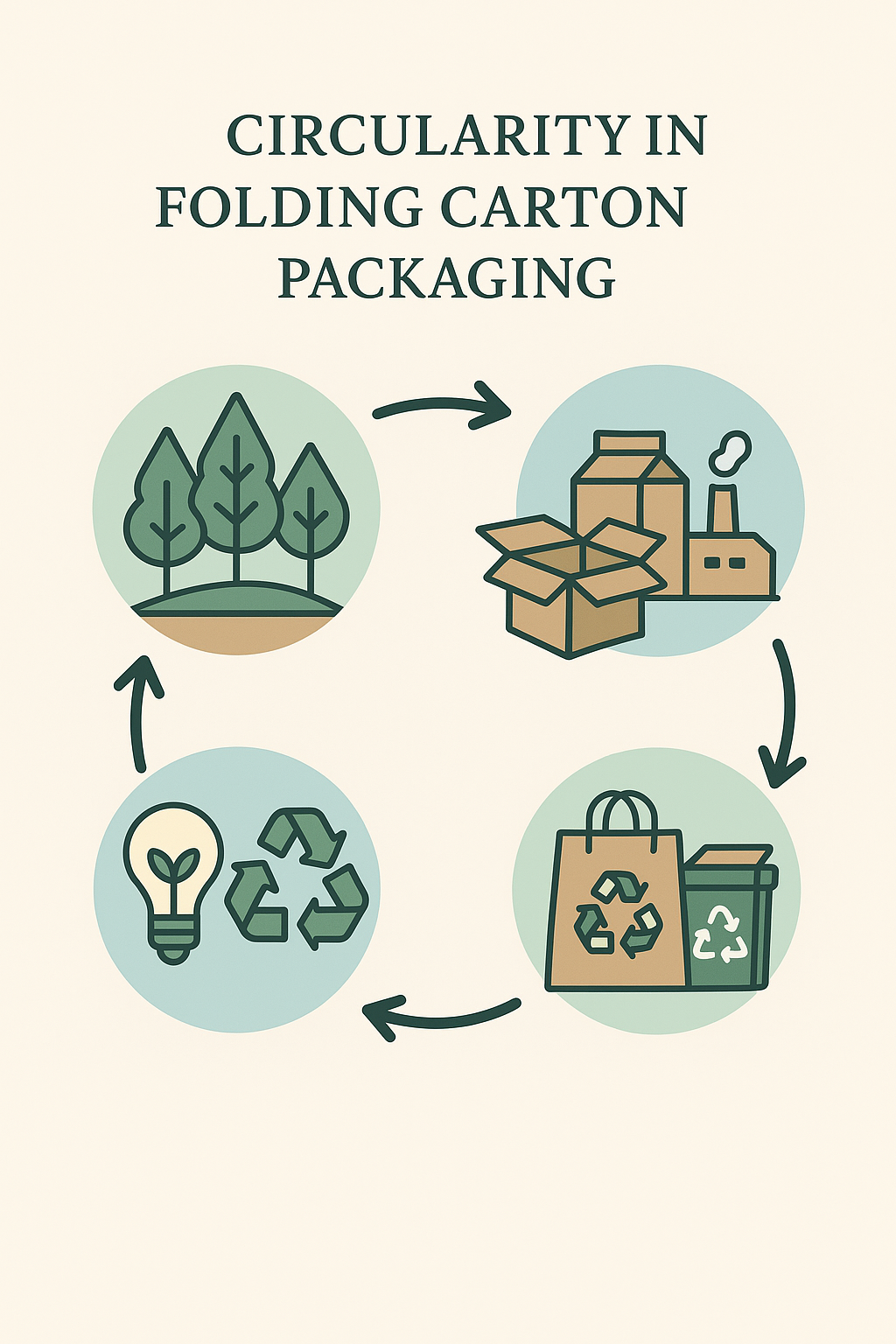
Circularity in Folding Carton Packaging: Turning Challenges into Opportunities
The packaging industry stands at a critical turning point. With heightened environmental awareness, tightening regulations, and shifting consumer expectations, circularity has moved from being a “nice to have” to a business necessity. For folding carton packaging, this transition is both a challenge and an opportunity, one that demands innovation, collaboration, and clear communication.
Traditionally, packaging followed a linear model: make, use, dispose. This approach not only depletes finite resources but also places an increasing strain on waste management systems. Circularity flips the model, designing packaging so materials can be reused, recycled, or composted, keeping them in circulation for as long as possible.
Folding carton already has an advantage: it is made primarily from renewable, fibre-based materials, often sourced from sustainably managed forests. With high recycling rates across Europe, carton board is well positioned to lead the way. However, achieving true circularity requires going beyond material choice, it’s about ensuring the entire system supports the loop.
Circular design starts at the drawing board. Packaging should be easy to collect, sort, and process. This means avoiding unnecessary complexity, such as incompatible material combinations, and prioritising inks, coatings, and adhesives that do not interfere with recycling.
Innovations in water-based coatings, barrier solutions that replace plastic films, and glue systems designed for clean fibre separation are paving the way for more efficient recycling. Importantly, these solutions must balance sustainability with functionality, protecting the product, extending shelf life, and delivering on brand requirements.
Shoppers are increasingly aware of environmental claims and expect brands to “walk the talk.” Folding carton packaging’s natural, tactile quality already resonates with consumers looking for authenticity and responsibility. However, effective communication is key. Clear recycling instructions, visible sustainability logos, and transparent claims help consumers make the right disposal decisions, closing the loop in practice, not just theory.
While circularity is a shared goal, it requires constant innovation. Digital printing technologies enable smaller, on-demand production runs, reducing waste. Smart packaging features, such as QR codes, can guide consumers to recycling information or explain a pack’s environmental benefits. Lightweighting, structural redesign, and material efficiency help reduce environmental impact without compromising performance.
The real breakthroughs happen when packaging companies collaborate with brands, suppliers, recyclers, and policymakers. Cross-industry partnerships can help align material standards, improve collection systems, and support infrastructure investment.
Legislation in the EU and beyond is pushing packaging producers toward circular models. Extended Producer Responsibility (EPR) schemes are making brands accountable for the full life cycle of their packaging. Deposit return systems, harmonised recycling symbols, and stricter rules on single-use plastics are all nudging the market toward fibre-based, recyclable solutions.
For folding carton, this is both a challenge, as it must keep evolving, and a unique market opportunity. Brands are actively seeking packaging that can meet both compliance requirements and consumer expectations, making innovation in carton board more valuable than ever.
Circularity is not a passing trend; it is the future of packaging. For folding carton, the path forward involves continuous improvement in design, production, communication, and collaboration. By embracing this change, the industry can reduce waste, conserve resources, and strengthen its position as a leader in sustainable packaging.
After all, in a truly circular economy, what we design today shapes the resources we’ll have tomorrow
For more information please visit: www.durandogan.com

The case for collaboration in circular packaging innovation
The case for collaboration in circular packaging innovation
Krzysztof Krajewski, Chief Innovation & Sustainability Officer at RDM Group
The shift to circular packaging is picking up speed, but manufacturers still face huge, shared challenges: making packaging both functional and recyclable, keeping up with regulations, and pushing material innovation. The problem? Most don’t have all the tools or R&D capacity to solve this quickly, alone.
Rather than attempting to cover everything, companies often focus on a specific material or type of packaging, to position themselves to excel in that niche.
But focusing on one material, with its own properties, can impose constraints when it comes to developing new concepts or innovation. For example, a fibre-based container will never achieve the barrier properties of plastic packaging alone, just as rigid plastic cannot replicate the pure, natural profile of paper. Companies that attempt to master both domains face the dual challenge of competing against specialists who have spent decades optimising single-material solutions, working in “industrial silos” while also managing fundamentally different material engineering, value chains, recycling processes and infrastructure or regulatory requirements.
This is where collaboration comes in, bringing separate expertise together to benefit both companies to be able to deliver results that would not otherwise be possible. A great example of this is RDM Group’s recent collaboration with Ecopol to launch a fully recyclable, barrier board – a breakthrough solution for oxygen, aroma-sensitive and opening new possibilities for food-safe applications.
RDM Group and Ecopol: pilot product “Ecolaminate”
The collaboration between RDM Group and Ecopol demonstrates how cross-industry partnerships can address the technical challenges that have historically limited circular packaging solutions. By combining RDM’s expertise in recycled fibre cartonboard with Ecopol’s specialised biodegradable PVOH film technology, the partnership aims to tackle both structural and barrier requirements within a single recyclable system.
RDM Group brings decades of experience in fibre-based substrates and recycling infrastructure, providing the foundational material that enables end-of-life processing through existing waste streams. Ecopol contributes its transparent, water-soluble PVOH film technology, which delivers critical barrier properties against oxygen, grease, and mineral oils whilst maintaining recyclability and biodegradability. This complementary expertise allows the partnership to address applications requiring extended shelf-life and traditionally dominated by multi-layer laminates.
Collaboration as a way of hitting PPWR targets
Our partnership with Ecopol highlights how strategic collaborations can help overcome the complex challenges posed by the upcoming PPWR regulations. With key deadlines fast approaching, including recyclability by 2030 and large-scale recycling by 2035, innovations like fully recyclable PVOH-laminated cartons are becoming essential.
For businesses investing in sustainable packaging, choosing the right partners is just as important as the technology itself. Collaborating with packaging innovators ensures brands can adapt to evolving legislation while staying ahead of the curve.
And it doesn’t stop there – cross-industry partnerships must also extend to converters and brand-owners. Building value chains that can handle a wide variety of packaging formats is critical to making recycling easier and more accessible for consumers at scale.
Moving forward together
The path to circular packaging innovation cannot be walked alone. As regulatory requirements become increasingly stringent and consumer expectations continue to evolve, the companies that thrive will be those that recognise collaboration as a strategic imperative, not just an option.
The future belongs to partnerships that combine specialised expertise, shared infrastructure, and coordinated innovation. By embracing collaboration over competition in sustainability challenges, the packaging industry can accelerate the transition to truly circular solutions whilst maintaining the performance standards that modern commerce demands.
For more information, please visit: rdmgroup.com