


 English
  French
  German
  Spanish
  Italian

This year’s Packaging Dialogue 2025 was dedicated to a topic that will shape our future and that of our companies: Sigrid Stagl, socioeconomist and Scientist of the Year 2024, outlined the “transformation to a resilient, sustainable economy.” Following this, the event focused on opportunities and possibilities under the motto “The future of success is ecological.” The awards ceremony for the Carton Austria Award 2025 and the PROPAK Austria Pro Carton Young Designers Award crowned the event.
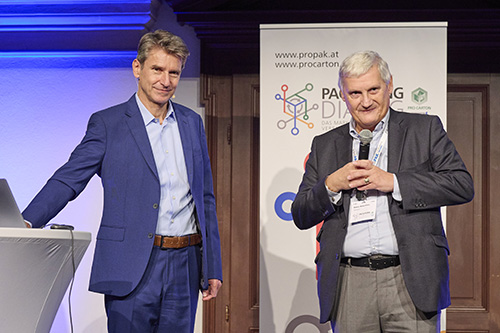
Horst Bittermann, Director General of Pro Carton, opened the evening together with Martin Widermann, Managing Director of PROPAK Austria.
Photos © Klaus Titzer
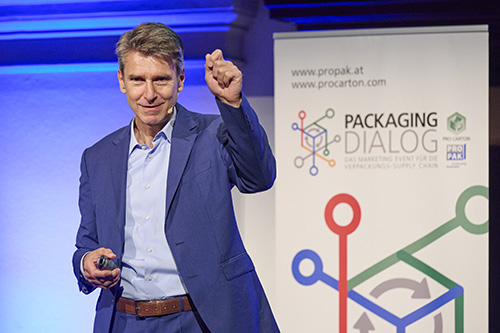
Horst Bittermann then gave an overview of the cartonboard and folding carton industry:
The fact is, we have a great product; our raw materials and recycling are the best of all. 98 percent of the wood we process comes from Europe; the European forest grows by 1,500 football fields every day and absorbs 20% of the EU’s CO2 emissions. That’s far more than the Amazon rainforest absorbs, and that’s because European forests are managed sustainably.
With a recycling rate of 86.6%, paper and cardboard lead by a wide margin, ahead of all other materials. Our goal is 90% by 2030. 52 million tons of paper and cardboard are collected annually, and our fibers can be recycled virtually indefinitely. The recycling content of fiber-based packaging is already at 76%.
Europe must become more independent. The conditions for this are good, because we have the machines, the raw materials, the producers, the customers, the customers’ customers, and recycling firmly in our hands, in Europe. Our greatest advantage is our well-trained workforce. While in China less than 20% have a vocational qualification and in the USA only around 30 percent, in Europe the figure is 70%. So Europe has the best workforce in the world. We must leverage this advantage. We also have the best products, and 89% of customers prefer cardboard and folding carton packaging to plastic packaging.
The challenges are great:
- We are dependent on exports, and the US’s 15 percent tariff is particularly painful.
- We have very high energy costs, higher than in the US, China, and even Turkey. Something must be done about this if Europe’s industrial sector is to be preserved.
- The costs of raw materials are high.
- The prices of imports from China, for example, are below our production costs, so we no longer have any margins in some areas.
- Diverse regulations exist in the countries of the Union: In order to reduce our costs, uniform legislation in the EU is urgently needed, the key word being a single internal market.
Accordingly, exports are declining: in 2021, 20 million tons of paper and cardboard were exported, but in 2024, this figure fell to just 15.8 million tons. At the same time, imports have increased, resulting in a total loss of 4.8 million tons from the market.
We have the opportunity to use our resources and become better than the rest of the world. But we also have to DO it.
“Transformation to a Resilient, Sustainable Economy”
by Prof. Dr. Sigrid Stagl, socioeconomist and Scientist of the Year 2024, founder and director of the Institute for Ecological Economics at the Vienna University of Economics and Business. She also heads the Competence Center for Sustainability Transformation and Responsibility.
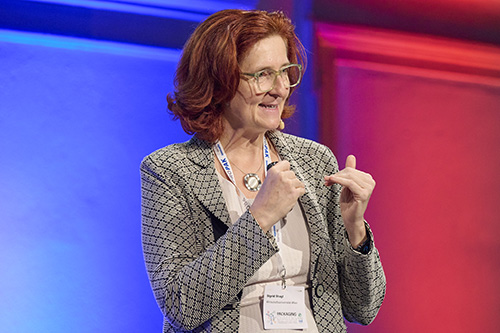
There’s a lot of bad news coming from climate and environmental research. We’re plundering the planet in many areas. The biophysical accounting of global resource consumption is negative. The good news: We can manage the problems, but we have to approach them wisely.
The high level of resource consumption is based on significant inefficiency, which is unsustainable in the long term and jeopardizes our competitiveness. Our economy must be built on biophysical principles. Because only when nature functions well can our economy function. Currently, nature is not doing well.
We are operating unstable in a total of seven areas, which is associated with very high risks. Our greatest concern is not climate change, but biodiversity, ocean acidification, and microplastics. The fact that we have succeeded in reducing the ozone hole gives us hope. The ozone problem will be repaired by 2060, both through technical measures and through mitigation. Regarding climate change, we must act now. Reducing greenhouse gases would be very important, because if we have to extract the CO2 from the air in the future , it will be very expensive.
Our market rules must be aligned with planetary boundaries. Currently, market rules dictate that organic products are expensive and industrial products are cheaper. But in reality, organic is much cheaper from an economic perspective. Therefore, there are externalities that aren’t accounted for in the market, and we must take these into account. This also means that a circular economy will deliver real cost savings.
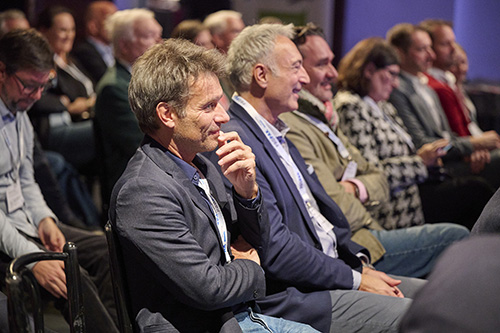
Markets are not, as many believe, simply optimization machines. A functioning market is not a natural given, but a historically evolved system influenced by laws. Markets are rules. They consist of social norms, legal requirements, and conventions. It’s all about changing the rules! Such a transformation succeeds by changing one rule at a time—in legal regulations, in the financial system, and so on. Innovation must be accompanied by exnovation: In some areas, we cannot keep doing more and more; instead, we must dismantle certain systems in an orderly manner.
In the future, we must create an ecosystem where nothing is waste. We must consider biological limits and ecological carrying capacity. Today, markets ignore these limits. We still have the choice to manage transition risks and opt for an orderly transition. If a disorderly transition occurs because other crises seem more important to us, significant additional economic costs will arise. Therefore, we must reduce both physical and transition risks! Of course, this will cost something, but nowhere near as much as with high risk.
To close the climate investment gap, approximately $9 trillion is needed worldwide. By comparison, COVID cost approximately $12 trillion in 2020. And we’re still subsidizing fossil fuels worldwide with $7 trillion! That’s a bit perverse. Overall, it’s clear that redirecting financial resources to green finance would be expensive but economically feasible. There’s enough money in circulation to achieve the ecological transition.
Austria is making good progress, but not yet good enough. We have reduced our emissions by about 6% for three consecutive years, a third of which was due to the recession. Mathematically, we would need 8% per year to achieve our goal of neutrality by 2040. To achieve this, we would need to invest 1.3 to 2.4% of gross domestic product, which would amount to €6.4 to €11.2 billion. The elimination of climate-damaging subsidies alone would generate €5 billion.
At our workshops in the country, we repeatedly experience people engaging productively and with joy. Once invited, they want to be part of the solution. The message: Together we must envision sustainable futures and work toward their realization.
Panel discussion
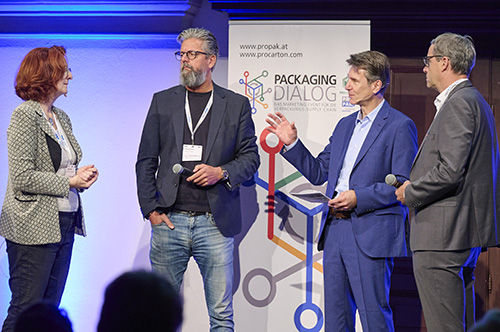
The presentations were followed by a lively discussion with Sigrid Stagl, Stephan Ratt, Managing Partner of the Rattpack Group, and Marko Schuster, Chairman of PROPAK Austria (right), moderated by Horst Bittermann. Here are the key points:
Can we afford the transition?
Stephan Ratt: We’ve established a dedicated department for sustainability. The greatest lever for production optimization lies in the sustainability of our facilities and buildings.
Would tariffs be justified?
Marko Schuster: Cheap imports, tariffs, and environmental regulations lead to harmful and unfair competition. We must intervene in the market to create fair conditions.
Please give us five sentences to conclude.
Sigrid Stagl: We have to take environmental problems seriously; we can’t ignore them. The transition is a major challenge, but if we implement it, we’ll be more competitive afterward. It’s difficult for companies alone; the rules also need to be changed. Your industry is energy-intensive, and that’s the big challenge—the product isn’t the problem. You have the potential to overcome the challenge.
Carton Austria Award ceremony
This year, for the eighth time, the Carton Austria Award honored the best Austrian folding cartons on the European market. This time, the jury of the CASH trade magazine chose the ” Kotányi Advent Calendar ” from Bösmüller Print Management , made of MM Board & Paper . Other finalists were Läderach Mini Mousse and Alfkens Hof Beerenschale , both from Schwarzach Packaging, made of Stora Enso cartonboard . The public voted for ” DosenKARTON ” from Cardbox Packaging, made of Weig cartonboard .
Horst Bittermann, Martin Widermann, and Marko Schuster jointly expressed their gratitude for the outstanding collaboration with CASH Handelsmagazin, which supports the successful award, ensuring it reaches a broad audience and demonstrates to future partners “what we can do.”
Award ceremony for the PROPAK Austria Pro Carton Young Designers Award
For the first time, the PROPAK Austria Pro Carton Young Designers Award was also presented at this event. The awards for best young packaging design went to Alexander Grube for “Capaging” and Jovan Berges for “diPaScale.”
Save the date: The next Packaging Dialogue will take place on October 6, 2026, again at 5:00 PM in the Marx Restaurant.
Recruiting. If a large company receives numerous applications using AI, AI can be used to develop questions for a multi-stage process that will help to make a good decision anyway (Kürner).
Recruiting still relies on human judgment, but in the future there will be 10 to 15 percent fewer people in each generation, and that means we will run out of employees. AI can help us present our companies attractively and develop our own campaigns to attract employees (Bittermann).
Introduction. With smaller projects, you can keep the investment costs low. Small and medium-sized companies in particular can benefit from AI because there are fewer different departments. AI is ideal wherever more needs to be achieved with fewer people. However, you often need support when introducing a tool (Kürner).
Fake. As far as the authenticity of information and images is concerned: young people often already have some experience and intuitively understand where suspicions might arise. But the sender is always the decisive factor: fake news will increase, and ultimately the assessment of the authenticity of a message or image depends on whether you trust the sender (Kürner).